





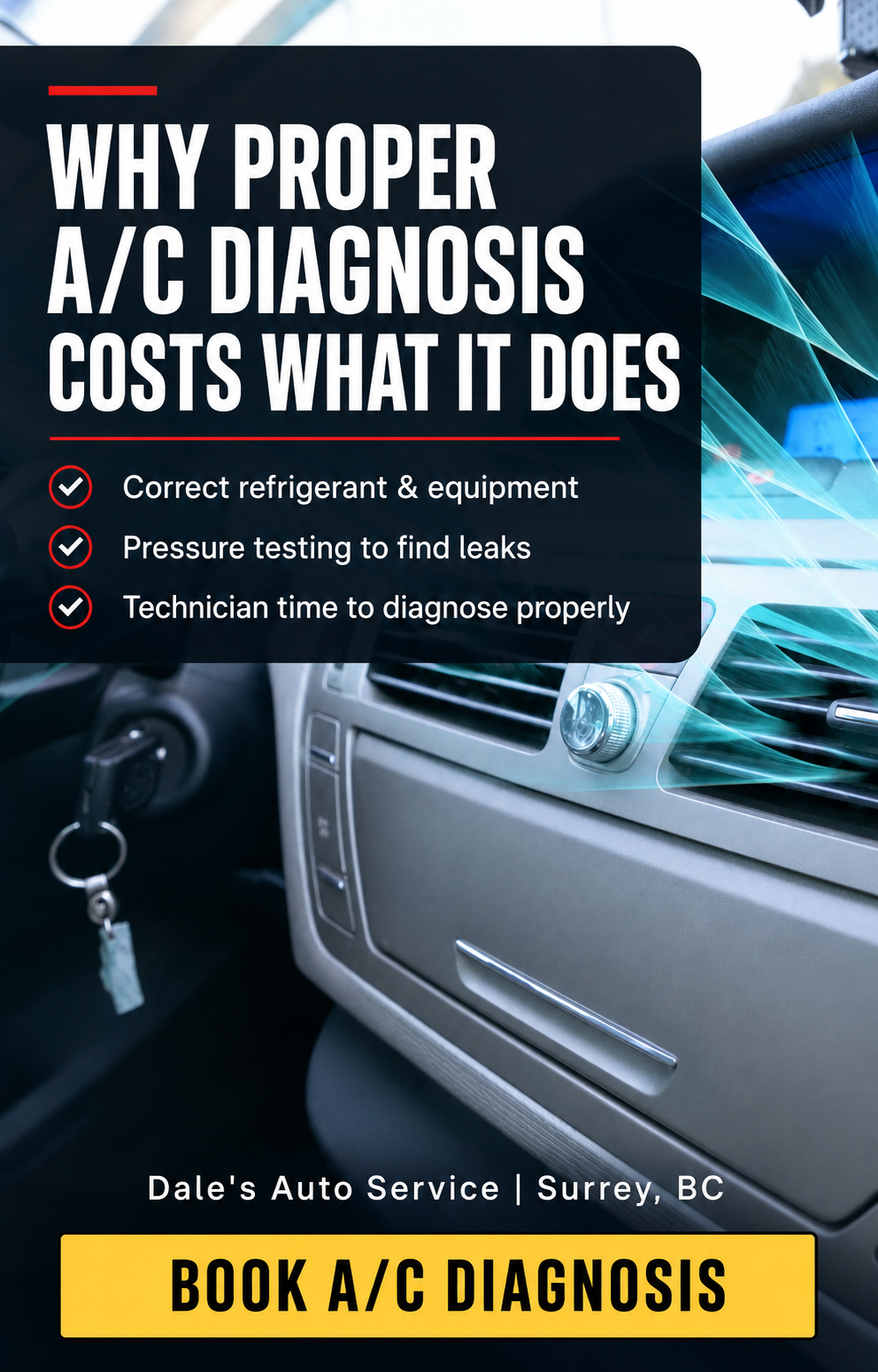
Why Proper Auto A/C Diagnosis Costs What It Does
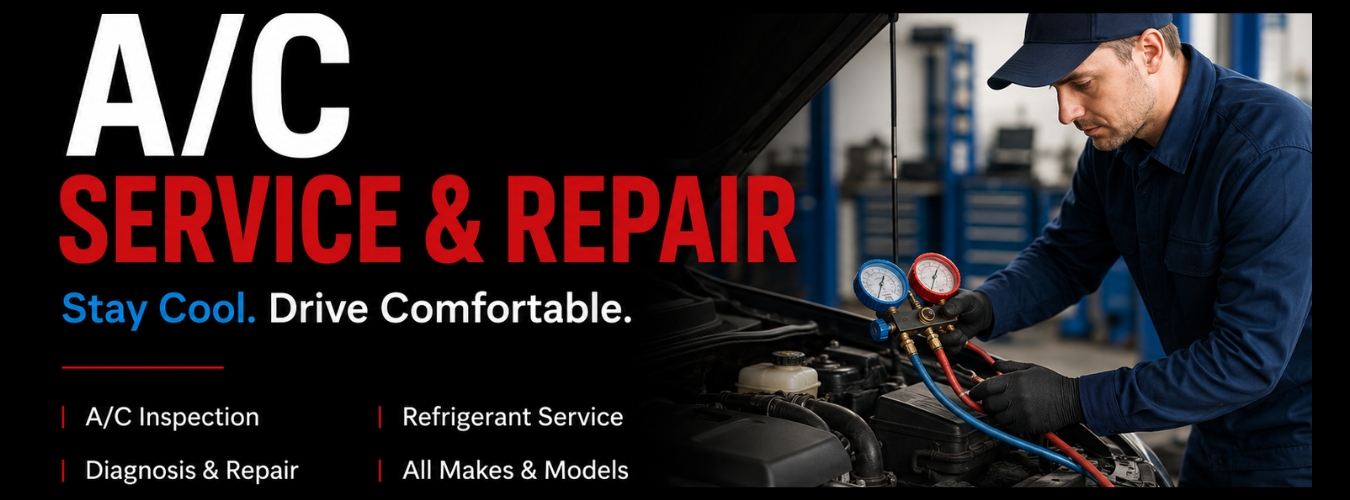
When your vehicle’s air conditioning stops blowing cold, it can seem like it should be a simple “top up.” In reality, modern automotive A/C systems are sealed, pressurized systems that require the correct equipment, refrigerant, procedures, and technician time to diagnose properly.
At Dale’s Auto Service in Surrey, BC, our goal is not to simply add refrigerant and send you down the road. Our goal is to find out why the A/C is not working, explain the issue clearly, and repair it properly.
A/C Refrigerant Should Not Just Disappear
One of the most common misunderstandings with vehicle air conditioning is that refrigerant gets “used up.” It does not.
Your A/C system is designed to be sealed. Unlike fuel, engine oil, washer fluid, or coolant, refrigerant should not normally drop over time. If the system is low, there is usually a reason.
That reason is often a leak.
Low refrigerant can be caused by:
- A leaking condenser
- Failed O-rings or seals
- Damaged A/C hoses or lines
- Compressor leaks
- Evaporator leaks
- Damaged service ports
- Corrosion or impact damage
- Previous improper repairs
- Contamination from stop leak or incorrect refrigerant
This is why simply topping up an A/C system is not a proper repair. It may make the air blow cold temporarily, but it does not solve the actual problem.
Why We May Need to Add Refrigerant to Find the Leak
A proper A/C diagnosis often requires the system to be under pressure. If the system is empty or extremely low, there may not be enough pressure to reveal where the refrigerant is escaping.
A good comparison is trying to find a puncture in a tire.
If a tire is completely flat, the hole can be hard to find. Once you fill the tire with air, the leak becomes easier to locate because pressure helps show where the air is escaping.
An A/C system works the same way. In some cases, we need to add the correct refrigerant and leak detection dye so the system can be pressurized and tested properly. That allows us to trace where the leak is coming from instead of guessing.
This is part of diagnosis. It is not just “adding freon.”
Why Proper A/C Diagnosis Has a Cost
A professional A/C diagnosis involves more than connecting a can of refrigerant.
It can include:
- Technician inspection time
- A/C machine setup and service time
- Recovering any remaining refrigerant
- Vacuum testing the system
- Measuring system pressures
- Adding the correct refrigerant by weight
- Adding leak detection dye when required
- Checking compressor operation
- Inspecting condenser, lines, seals, and service ports
- Testing temperature output
- Checking for electrical or control issues
- Documenting the findings
- Explaining the next repair steps
Modern vehicles are also more complex than older systems. Many use different refrigerants, electronic controls, pressure sensors, variable compressors, and very specific refrigerant capacities. Guessing can lead to wasted money or damaged components.
When we charge for A/C diagnosis, we are charging for the time, equipment, refrigerant, training, and process required to find the problem properly.
Why Different Refrigerants Cost Different Amounts
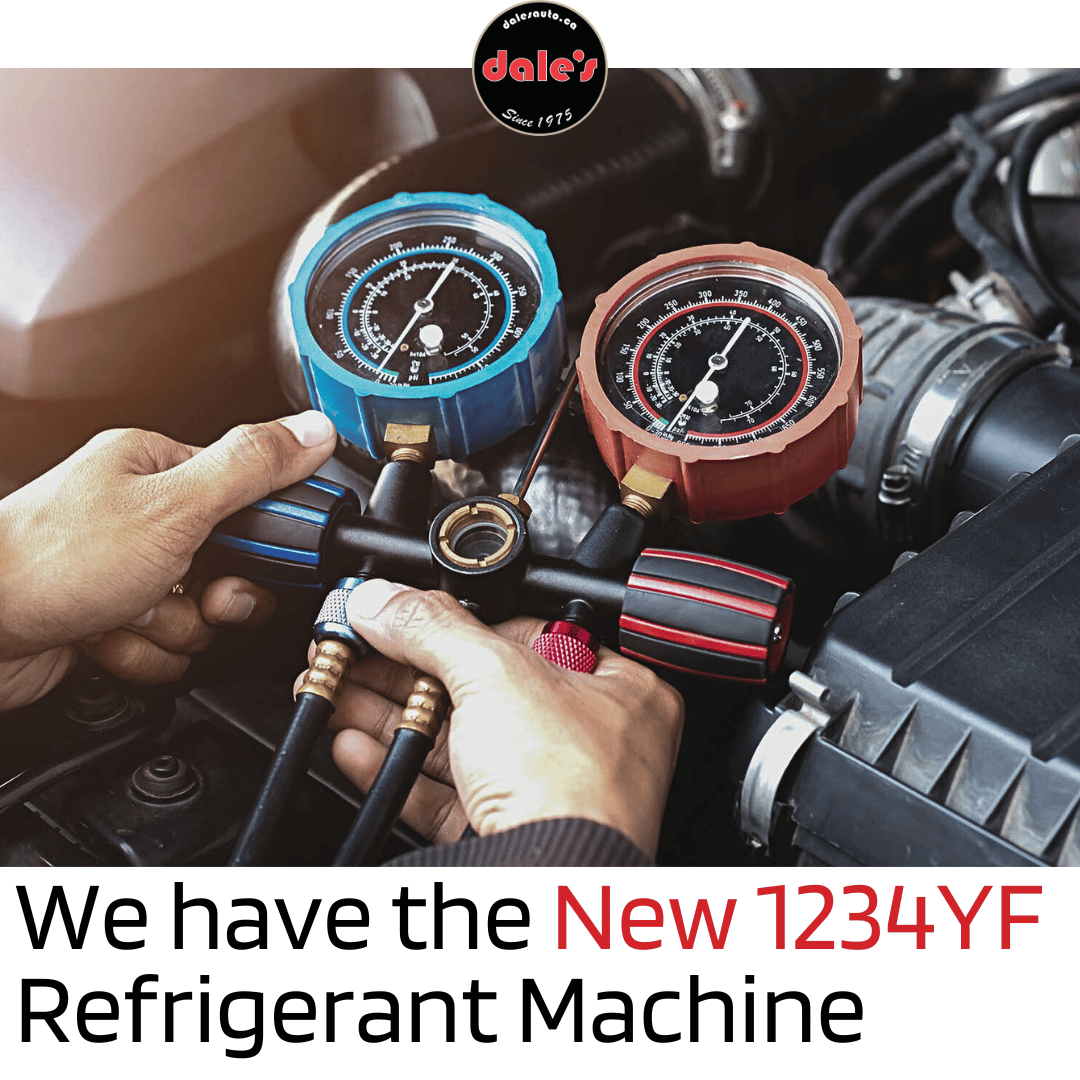
Not all vehicles use the same refrigerant. Many older vehicles use R134a, while many newer vehicles use R1234yf.
These refrigerants are not interchangeable.
R1234yf is usually more expensive because it is a newer refrigerant designed to meet stricter environmental standards. It also has higher supply costs and requires dedicated equipment and handling procedures.
Using the wrong refrigerant can:
- Damage the A/C system
- Contaminate service equipment
- Affect cooling performance
- Create safety concerns
- Increase repair costs
This is why the cost of A/C service can vary depending on the vehicle, the refrigerant type, and the amount required.
Why We Do Not Use A/C Stop Leak
A/C stop leak products may sound like an easy fix, but they can cause serious problems.
These products are designed to react when they contact air or moisture. The issue is that automotive A/C systems have small passages, valves, sensors, and components that can be damaged or plugged by these chemicals.
A/C stop leak can:
- Contaminate the system
- Plug expansion valves or orifice tubes
- Damage the compressor
- Affect sensors and service ports
- Damage professional A/C service equipment
- Turn a normal leak repair into a much more expensive repair
For this reason, Dale’s Auto Service does not recommend stop leak products. The proper repair is to find the leak and repair the failed component or seal.
What If the A/C System Is Contaminated?
If an A/C system is contaminated with stop leak, incorrect refrigerant, moisture, or debris, the repair becomes more involved.
In some cases, regular A/C service equipment cannot be safely connected until the system is assessed. Contamination can damage expensive service machines and spread through the system.
Depending on the issue, a contaminated system may require:
- Careful inspection
- Special recovery procedures
- System flushing where possible
- Replacement of contaminated components
- New receiver/drier or accumulator
- Replacement of the expansion valve or orifice tube
- Compressor or condenser replacement if damaged
- Proper evacuation and recharge after repairs
This is why a cheap shortcut can create a much larger repair bill later.
Why Cheap A/C Top Ups Can Cost More Later
A low-cost top up may seem appealing, but if the system is leaking, the refrigerant can escape again. That means the same problem returns, sometimes within days or weeks.
Even worse, if the wrong refrigerant, too much refrigerant, air, moisture, or stop leak enters the system, the repair can become more expensive than it needed to be.
Proper diagnosis helps avoid:
- Repeated recharges
- Unnecessary parts replacement
- Compressor damage
- System contamination
- Poor cooling performance
- Extra labour later
The goal is to repair the vehicle correctly, not just make it cold for a short period of time.
Servicing All Makes & Models
Audi, BMW, Mercedes-Benz, MINI, VW, Volvo, Subaru, Toyota/Lexus, Honda/Acura, Ford, GM, RAM, Jeep, Hyundai, Kia, Mazda, Nissan/Infiniti, Porsche, Jaguar/Land Rover — all makes, all years.
Contact & Booking (Surrey)
Phone: 604-530-9160
Email: sales@dalesauto.ca
Auto A/C Repair FAQ
Why do I have to pay for A/C diagnosis?
Because proper A/C diagnosis requires technician time, specialized equipment, refrigerant handling, pressure testing, leak detection, and system inspection. It is not just a quick top up.
Can you just add refrigerant and see what happens?
That may temporarily make the A/C cold, but it does not fix the reason the refrigerant was low. If the system is leaking, it needs to be diagnosed and repaired properly.
Should my A/C refrigerant be low?
No. Your A/C system is sealed. If the refrigerant is low, there is usually a leak.
Why does refrigerant cost more on some vehicles?
Some vehicles use R134a, while many newer vehicles use R1234yf. R1234yf is usually more expensive and requires dedicated equipment and handling.
Why can’t I use A/C stop leak?
Stop leak can contaminate the system, plug small passages, damage components, and damage professional A/C service equipment. It can make the final repair much more expensive.


ATTN: A/C Diagnosis & Repair
For accurate A/C diagnosis and repair, we require your vehicle to be brought to our facility. Unfortunately, we cannot provide an estimate without conducting a thorough inspection ourselves.
Rest assured, we prioritize the integrity of our services. We will only offer repair solutions and estimates based on our own diagnosis, ensuring the most reliable results for your vehicle.
We are proud to have three licensed technicians specialized in A/C repair, guaranteeing top-notch expertise for your needs.

A/c Service